
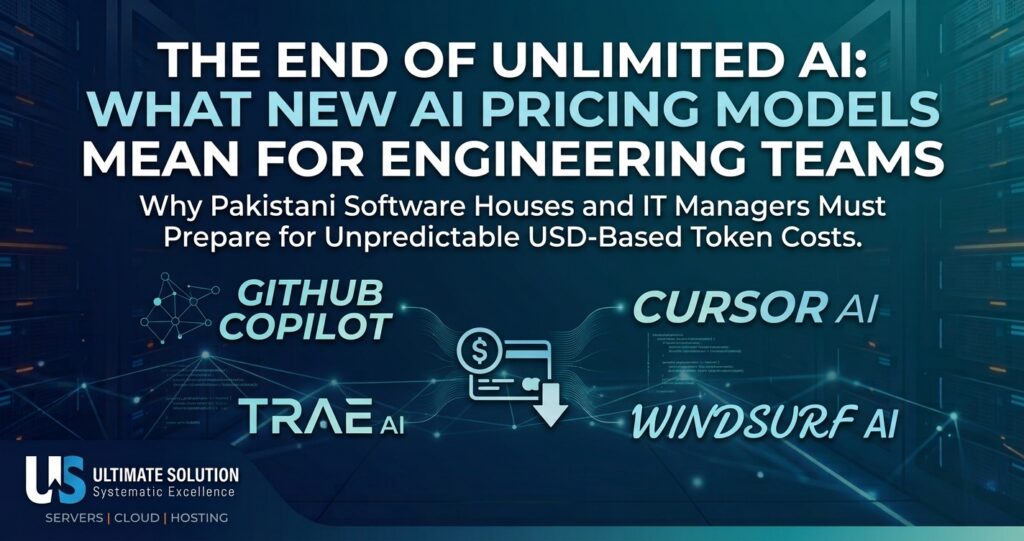
For the last three years, developers and IT companies in Pakistan enjoyed a straightforward deal with AI coding tools like GitHub Copilot: pay a flat rate of $10 to $40 per month and generate as much code as you want.
That era of flat-rate, unlimited AI usage is coming to an end.
Major AI providers are moving toward pay-per-use, credit-based, and usage-heavy billing models. Even as newer competitors like TRAE AI (ByteDance’s AI IDE), Cursor, and Windsurf enter the market with low entry pricing or usage credits, they all rely on the same fundamental token-based mechanics. For local software houses, IT departments, and engineering leads, this shift introduces one major challenge: unpredictable monthly bills in USD.
Here is what is changing, why it’s happening, and how Pakistani IT businesses should prepare.
1. From Fixed Monthly Plans to Pay-Per-Prompt Billing
The flat-rate $10–$40/month model was heavily subsidized by tech giants taking losses to gain market share. Running complex AI models (LLMs) requires immense computing power, and providers are now passing those real costs down to users through token quotas and usage caps.
| Feature | The Old Model (2021–2024) | The New Reality (2025 Onward) |
| Pricing Structure | Flat monthly fee per user seat | Pay-per-prompt / Token-based usage |
| Cost Predictability | Fixed monthly IT expense | Variable monthly bill based on token consumption |
| Team Pool Risk | Individual seat licenses | Shared credit pools (one heavy user drains all credits) |
| Heavy Usage Impact | No financial penalty | Rapid credit exhaustion & overage fees |
Key Takeaway for Managers: In a shared team plan, if a couple of developers run heavy prompts, automated agent tasks, or full codebase reviews, your team’s monthly credit pool can run out in a matter of days.
2. Why Switching Tools (Cursor, TRAE, Windsurf) Is Only a Temporary Fix
As Copilot updates its pricing, many local developers are hopping across platforms—moving to Cursor, Windsurf, or trying TRAE AI for its aggressive pricing and multi-model access (Claude, GPT, Doubao).
While switching tools provides temporary cost relief or generous free usage tiers during promotional periods, every AI provider faces the exact same infrastructure economics:
- Inference Costs Are Constant: Whether you use GitHub Copilot, Cursor, Codex, or TRAE AI, the underlying LLM inference compute costs real money.
- Unpredictable Dollar Expenses: In Pakistan, where IT budgets are strictly managed against fluctuating USD exchange rates, replacing fixed salaries with unpredictable, usage-based cloud and API bills makes budgeting extremely difficult.
- Technical Debt Risk: AI tools generate code fast, but they don’t replace system architecture or security checks. Without experienced senior engineers to audit and secure the output, technical debt and server performance issues stack up quickly.
3. The Hidden Driver: Data Center Power & Cloud Costs
Why are AI providers making this shift now? The main reason isn’t software—it is physical infrastructure and energy limits.
+--------------------------------------------------------------------------------+
|                        THE AI INFRASTRUCTURE COST LOOP                         |
+--------------------------------------------------------------------------------+
|                                                                                |
|   [ High AI Prompt Usage ] ----> [ Massively Higher Power & Server Load ]      |
|                                                  |                             |
|                                                  v                             |
|   [ Increased API Bills ] <----- [ 76% Price Surge in Data Center Power ]      |
|                                                                                |
+--------------------------------------------------------------------------------+
- Surging Power Costs: Major U.S. data center operators report up to a 76% increase in power capacity pricing due to high-density AI workloads.
- Environmental & Resource Strain: UN reports warn that data center power and water usage needed to cool AI servers will double in the coming years.
- Market Realities: Financial analysts are urging tech companies to drop “unlimited” plans because running AI inference at scale is simply too expensive to offer for free or cheap long-term.
How Pakistani IT Leaders Should Prepare
To keep operational costs under control across changing AI pricing models, local tech leaders should:
- Audit AI Usage: Set clear usage policies for engineering teams to prevent wasteful prompting and track shared credit consumption across tools like Copilot, Cursor, and TRAE.
- Strengthen Infrastructure Control: Balance cloud-based AI tools with localized, self-hosted, or dedicated server resources where workload costs remain 100% predictable.
- Invest in Core Engineering Skills: Treat AI as an efficiency tool for skilled developers—not as a substitute for solid code review, network security, and infrastructure planning.